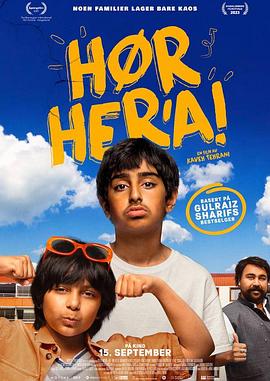
Kaveh Tehrani's coming-of-age film is an adaptation of Gulraiz Sharif's 2020 novel, depicting the increasingly complex summer vacation of 15-year-old Mahmoud. Not only does a sociable uncle from Pakistan visit, but Mahmoud must also navigate the family crisis that unfolds when his little brother Ali has a secret that turns their whole world upside down.
It doesn't take long for the film to set the tone: The protagonist, Mahmoud, almost immediately breaks the fourth wall, seamlessly taking on the role of the narrator. The film doesn't look back: it brims with techniques and devices that inject energy into the narrative and provide a framework for the themes, taking us under the skin of what turns out to be a poignant, thought-provoking family drama – all wrapped in the attractive guise of comedy.
Questions about identity and belonging in Norwegian society (for both young and older characters) within a multicultural family from Oslo become the central driving force. The adaptation of Gulraiz Sharif's book is solidly directed by debut filmmaker Kaveh Tehrani. While the film aims to maintain its entertainment value, it also carries a sharp political edge – directed equally against society's rigid class structures and conservative family traditions. The talented child actors in the lead roles carry the heart of the film on their shoulders, ensuring that few leave the theater untouched in the end.
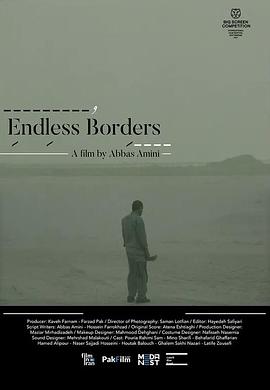
The story opens in Balochistan, in a small, scarcely ‘wired’ village bordering Iran and Afghanistan. Ahmad is an idealistic teacher in exile, educating the local community his partner Haseeba, however, has spent time in jail in Tehran for the very same offence against the State. The disaccord between them is not only social but also personal. Ahmad's destiny collides with that of a family fleeing the Taliban soon the intricate divisions of age and gender within that group will trigger other problems and entanglements – including a 'lovers on the run' intrigue that fleetingly recalls Murnau's classic Tabu (1931).
Across all the arresting, shifting peripeteia of its plot, Abbas Amini's film deftly dramatises the complicated question of commitment: do we commit ourselves to a political cause, a set of religious beliefs, or a person? And how do we negotiate the commitments of others, even those closest to us, when they are based on a very different value system?
With its sparse music score, densely naturalistic acting and unostentatious camera work, Endless Borders is almost a minimalistic suspense thriller (with Hitchcockian overtones), combined with a heated family melodrama – but it never loses sight of the serious and extremely timely issues that it raises.
源自:https://iffr.com/en/iffr/2023/films/endless-borders